|
Understanding the Basics of Ground, Grounding, and Ground Symbols Understanding the fundamentals of ground, grounding, and ground symbols is essential in electronics and electrical engineering. Not all grounds are the same. In this article, we will discuss ground, common ground, analog ground, and digital ground.
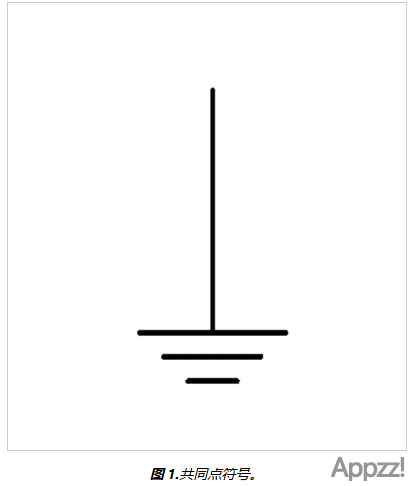
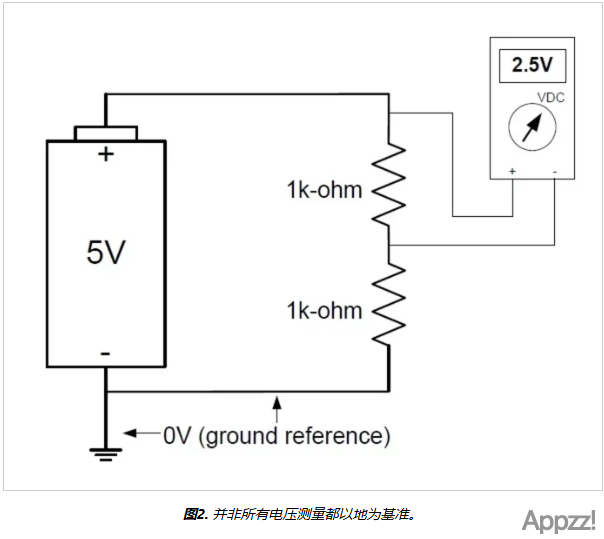
What Is Ground?In electronics and electrical engineering, it is common practice to define one point in a circuit as a reference point. This reference point is called ground (or GND) and is assigned a voltage of 0 V. Voltage measurements are relative measurements. In other words, a voltage value must be measured with respect to another point in the circuit. Otherwise, the measurement has no meaning. The ground reference point is usually (but not always) represented by a standard ground symbol (which will be explained in detail later). See Figure 1. Typically, this reference point serves as the basis for all other voltage measurements within the circuit. However, not all voltage measurements are made with respect to this reference point. For example, if you measure the voltage across the upper resistor in a resistor voltage divider, the reference point would not be ground. See Figure 2.
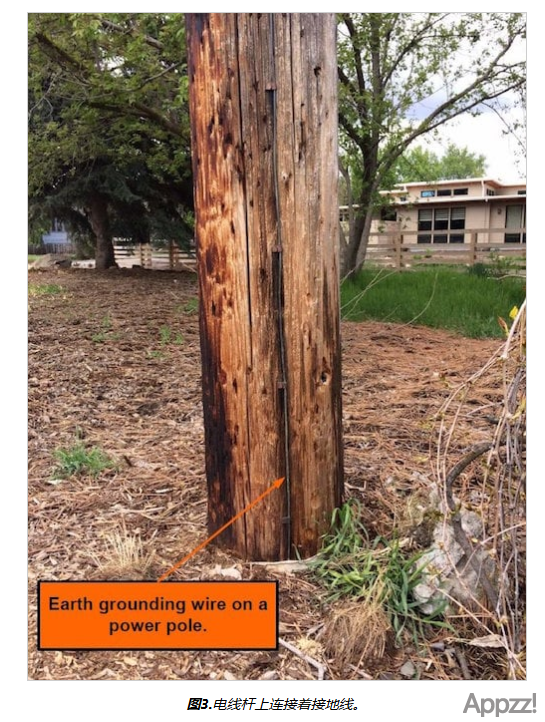
Earth GroundEarth ground is exactly what it sounds like. It is a ground connection that is physically (and electrically) connected to the earth through a conductive material such as copper, aluminum, or an aluminum alloy. According to the definition provided by the National Electrical Code (NEC), a true earth ground consists of a conductive pipe or rod that is physically driven into the earth to a minimum depth of 8 feet. The earth acts as an electrically neutral body. Due to its nearly infinite capacity to absorb charge, it is generally unaffected by electrical disturbances. However, it should be noted that the statement “the earth is unaffected by electrical disturbances” is a simplification. In reality, earth grounding is a complex subject because of the many variables and materials that make up the ground itself. For example, the earth’s potential can experience localized variations due to events such as lightning strikes. Utility poles — the poles that carry power lines throughout communities — are also connected to earth ground. Figure 3 shows a grounding conductor connected to a utility pole.
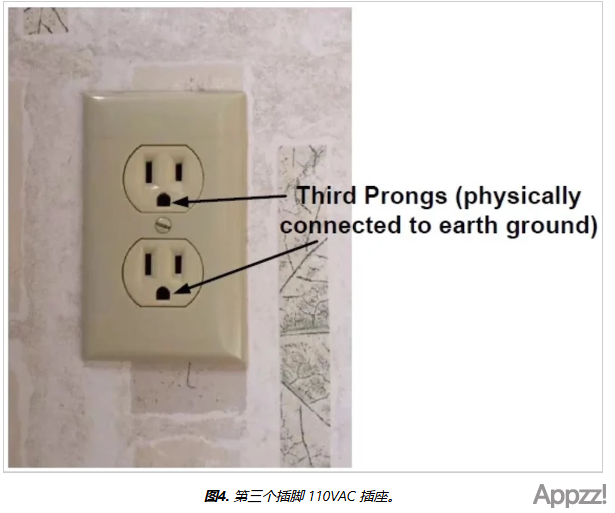
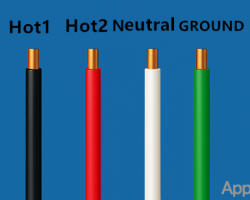
The third prong on a power outlet (see Figure 4) is physically connected to the earth ground. For example, the connection between this type of outlet and earth ground provides a way to connect test equipment to ground — the grounding (green) wire in the power cord is connected to the internal frame or chassis of the equipment. When various pieces of test equipment are grounded, they are all connected to a common grounding point and therefore share a common reference. You can verify this by measuring the resistance between the ground terminals of any two pieces of test equipment. This common reference is made available to the user in the form of a ground lead terminal. Side note: The chassis of your desktop computer is also connected to earth ground.

Unfortunately, the ground symbol is used in many applications in electronics and electrical engineering, and it often means different things to different people, which can be somewhat confusing for beginners. For example, the ground symbol is also used as a common ground symbol or a 0V reference. This can be misleading because the 0V reference is not necessarily connected to earth ground. Figure 6 shows various ground connections using the common/ground symbol. Digital circuits generate current spikes when digital signals change state. Similarly, when the load current in analog circuits changes, current spikes are also produced. Although there are various proper grounding techniques, when it comes to mixed-signal grounding, the most important principle—regardless of the specific method used—is to keep the “noisier” digital return currents separate from the “quieter” analog return currents. This separation helps minimize or prevent noise within the circuit caused by ground currents. When these ground currents (think of them as varying currents) flow through the ground path, they create voltage variations known as noise (recall Ohm’s Law). You may have heard the term “noisy ground.” This noise can degrade sensitive signals in nearby circuits. Grounding has long been a major challenge for design, systems, and test engineers. One possible grounding technique, which may be helpful in some (but not all) cases, is the so-called “star” grounding method. This concept is based on the principle that all voltages in the circuit are referenced to a single ground point. Figure 7 shows a single-point connection between analog and digital grounds.
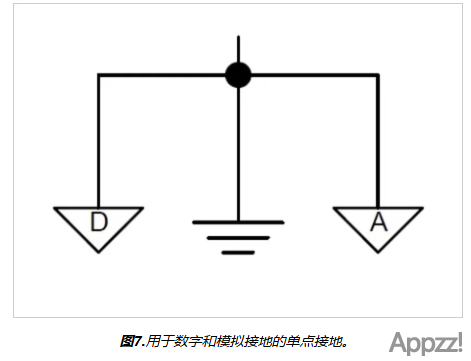
Using a Single Ground PointThe single-point grounding (or star grounding) method looks excellent on paper. However, in practice, depending on the complexity of the design, it can be very difficult to implement. Another approach is to use a ground bus. Keep in mind, though, that it is often unnecessary to physically separate analog and digital grounds. Even if a design uses a single (shared) ground plane, return currents can be properly managed through good PCB layout techniques.
Common Grounding MistakesA three-terminal DC power supply — such as the one shown in Figure 8 — can be confusing for beginners. This type of power supply has a positive (+), a negative (−), and a GND (ground) terminal. As mentioned earlier, the ground terminal (GND) is physically connected to the chassis, which is connected to the grounding conductor in the power cord, and ultimately connected to earth ground through a three-prong outlet. A common mistake beginners make is connecting the load between the positive (+) and GND terminals. This incorrect connection does not allow current to return to its energy source (the power supply itself), and therefore no current will flow. The correct connection is to place the load between the positive (+) and negative (−) terminals.

Electrostatic Discharge (ESD)Grounding test equipment also helps eliminate electrostatic discharge (ESD). ESD occurs when a statically charged object (that is, you) comes into contact with test equipment. Some test equipment is very sensitive and can be easily damaged by an ESD event. Integrated circuits (ICs) are well known for being highly susceptible to ESD damage. Grounded mats (called ESD mats), grounded chairs, and wrist straps provide adequate ESD protection for your ICs by grounding you before you touch any sensitive components, thereby discharging any static electricity that may have accumulated on your body. Most engineers and technicians also wear ESD-safe jackets when working with PCBs and ICs to provide additional protection for components and equipment that could otherwise be damaged.
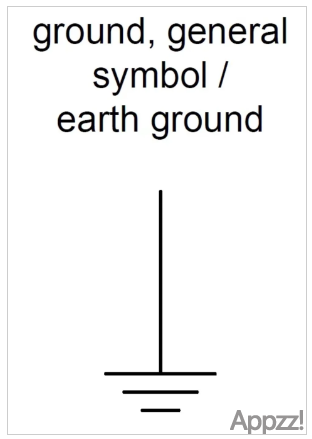
Ground SymbolsThe following ground symbols are some of the symbols commonly found in circuit designs: Figure 9. General ground symbol, or ground.
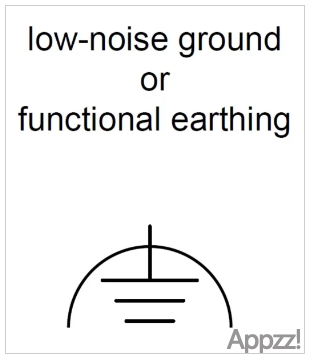
Figure 10. Low-noise ground, or functional ground.

Figure 11. Safety ground, or protective earth (PE).
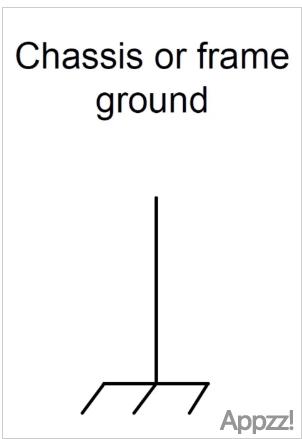
Figure 12. Chassis or frame connection.

Figure 13. Unspecified common connection / potential level.
|  English
 简体中文
简体中文 繁體中文
繁體中文 한국 사람
한국 사람 日本語
日本語 Deutsch
 русский
 بالعربية
 TÜRKÇE
 português
 คนไทย
คนไทย french