|
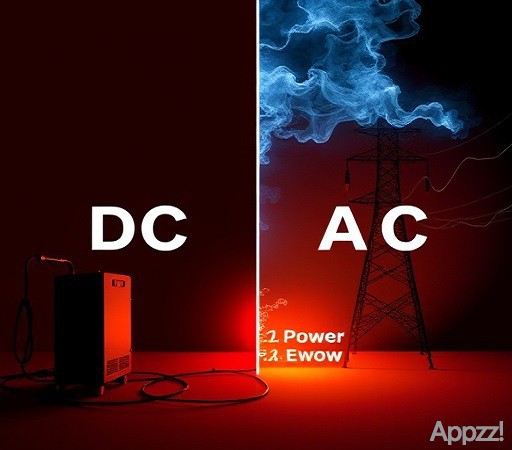
Direct Current (DC) and Alternating Current (AC) are the two primary forms of electricity in power systems. They differ significantly in characteristics, applications, and transmission methods. Below is a detailed comparison from multiple perspectives.
1. Current DirectionDC:
The current flows in a constant single direction, always from the positive terminal to the negative terminal. Common in batteries and solar panels. AC:
The current direction changes periodically, typically in a sine-wave pattern. The direction switches 50 times per second (50 Hz) or 60 times per second (60 Hz), depending on the country’s power standard.
2. Voltage CharacteristicsDC:
Voltage remains constant and stable, suitable for electronic components requiring steady power. AC:
Voltage varies over time. For example, household AC voltage in China is 220 V (RMS), but its peak voltage is about 311 V (RMS × √2).
3. Energy TransmissionDC:
Better for short-distance transmission with low loss. Historically inefficient over long distances, but modern HVDC (High-Voltage Direct Current) technology has greatly improved long-distance transmission efficiency. AC:
Ideal for long-distance transmission. Voltage can be easily stepped up or down using transformers, reducing transmission losses and making it the primary choice for power grids.
4. Generation MethodDC:
Produced by batteries, solar panels, or DC generators. AC:
Generated by alternators using rotating magnetic fields. Power plants typically use turbines to drive generators and produce AC electricity.
5. Application ScenariosDC:
Used in electronic devices, small motors, energy storage systems (such as electric vehicles), and solar systems. AC:
Widely used in industry, household electricity supply, and high-power equipment such as refrigerators, air conditioners, and motors.
6. Advantages and DisadvantagesDC Advantages: DC Disadvantages: AC Advantages: High transmission efficiency Easy voltage transformation via transformers Suitable for large-scale grid distribution
AC Disadvantages:
7. Historical DevelopmentDC power was promoted by Thomas Edison, while AC power was advanced by Nikola Tesla and George Westinghouse.
In the late-19th-century “War of Currents,” AC became dominant because of its superior long-distance transmission capability. Today, DC transmission is regaining importance in specialized applications.
8. Practical ComparisonFeatureDCAC
Current directionOne directionPeriodically reversing
Voltage changeConstantTime-varying
Transmission distanceBetter short distanceBetter long distance
Device compatibilityElectronicsIndustrial & household appliances
Main applicationsBatteries, solar, electronicsPower grids, heavy equipment
9. Technology TrendsRecent advances have made DC important again in energy storage and efficient transmission (e.g., HVDC interconnections and submarine cables).
Meanwhile, AC systems are improving through smart-grid technologies, enhancing flexibility and stability.
10. SummaryDC and AC each have advantages and limitations and complement each other in modern power systems.
AC remains the mainstream for power distribution due to efficiency and flexibility, while DC plays a crucial role in electronics, energy storage, and specialized transmission.
In the future, integrating both will further improve energy efficiency and reliability. | 
 English
 简体中文
简体中文 繁體中文
繁體中文 한국 사람
한국 사람 日本語
日本語 Deutsch
 русский
 بالعربية
 TÜRKÇE
 português
 คนไทย
คนไทย french